FREE DOWNLOAD
Free mileage log template for Ireland, with Revenue rates built in
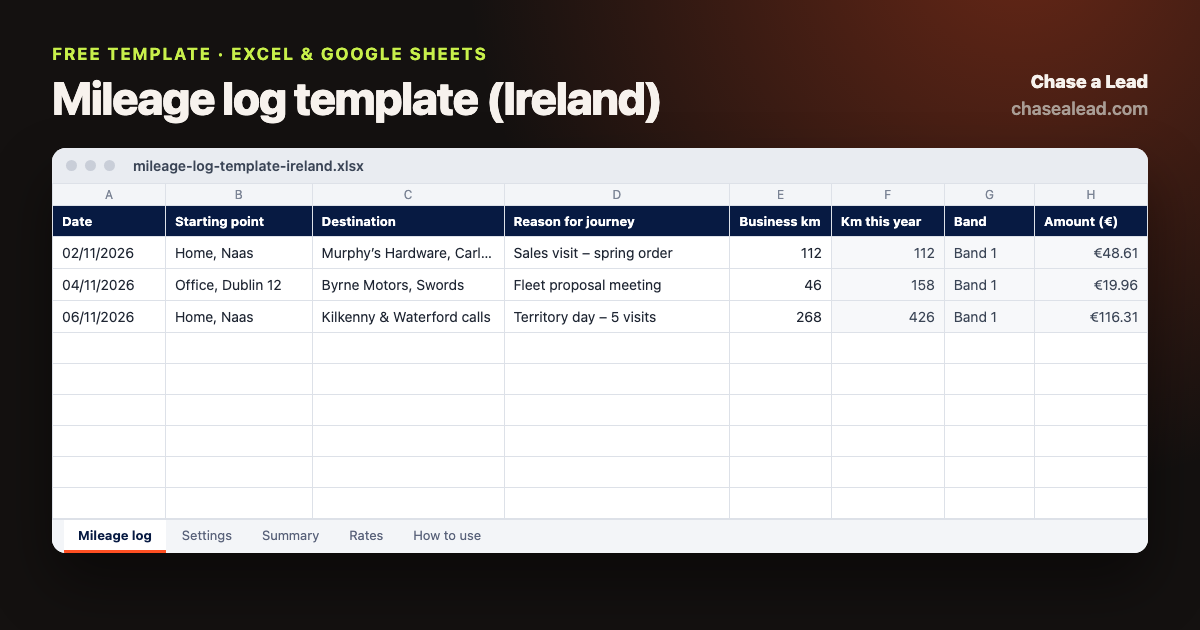
A business mileage logbook for anyone in Ireland who uses their own car for work. Record each journey once and the log works out what it is worth at the civil service rates — using the right distance band even when a trip crosses from one band into the next — then totals it by month for your expenses claim.
Last checked against official sources: 10 November 2026 (Revenue)
Free, no sign-up. Works in Excel, Google Sheets, Numbers and LibreOffice.
What is in the template
- Mileage log — one row per business journey. The running total, rate band and amount fill in automatically.
- Settings — your name, address, tax year, engine size and any kilometres already claimed this year.
- Summary — journeys, kilometres and the total claimable, plus a month-by-month breakdown.
- Rates — the civil service motor travel rates. If Revenue publishes new ones, type them in and every journey recalculates.
- How to use — six steps and what does and does not count as business mileage.
What a mileage record should show
Revenue’s guidance for employers paying flat-rate mileage lists the records they must keep for each journey. The log has a column for every one:
Record
Where it goes
Name and address of the employee
Settings tab
Date of the journey
Date
Reason for the journey
Reason for journey (turns red if left blank)
Kilometres travelled
Business km
Starting point, destination and finishing point
Starting point, Destination, Finishing point
Basis for the reimbursement
Rate band and Amount, from the Rates tab
Records Revenue expects for flat-rate mileage, and where they go in the log
Those records are kept for six years after the end of the tax year. Since 2024, employers also report tax-free mileage payments to Revenue under the Enhanced Reporting Requirements, so a clean log behind each payment matters more than it used to.
How the mileage calculation works
The civil service rates depend on your engine size and how many business kilometres you have driven so far in the year. The bands work like tax brackets: the first 1,500 km are paid at the Band 1 rate, the next 4,000 at Band 2, and so on.
The log keeps a running total and pays each journey for the kilometres it adds in each band. For example, in a 1.2–1.5 litre car with 1,400 km already driven, a 200 km trip is paid as 100 km at 43.40c and 100 km at 79.18c — €122.58, not 200 km at a single rate.
Business km in the year
Up to 1,200cc
1,201cc – 1,500cc
1,501cc and over
Band 1: up to 1,500 km
41.80c
43.40c
51.82c
Band 2: 1,501 – 5,500 km
72.64c
79.18c
90.63c
Band 3: 5,501 – 25,000 km
31.78c
31.79c
39.22c
Band 4: 25,001 km and over
20.56c
23.85c
25.87c
Civil service motor travel rates, cent per kilometre, in effect from 1 September 2022. Source: Revenue.
For the full explanation and an annual calculator, see Revenue mileage rates in Ireland.
What counts as business mileage
- Counts: driving to customers, site visits, meetings, trade shows, and between calls on a territory day.
- Does not count: your normal commute between home and your usual place of work.
- Starting from home: if you drive straight from home to a customer, the general rule is that you can be reimbursed for the shorter of the distance from home and the distance from your normal place of work.
- Rates are a ceiling: the civil service rates are the most an employer can pay tax-free. Your employer can pay less, and some journeys use reduced rates the log does not apply.
On the road all day?
Chase a Lead keeps your leads, visits and follow-ups on your phone, organised by county — so the trip in your mileage log and the conversation that justified it are never far apart.
Frequently asked questions
Do I need to keep a mileage log in Ireland?
If your employer pays you a flat rate per kilometre for using your own car, Revenue expects them to hold a record of each business journey — the date, the reason, the start, destination and finish, and the distance. A mileage log is the simplest way to give them that, and to check your own claims add up.
How long should I keep mileage records?
Revenue’s guidance is that employers keep these records for six years after the end of the tax year they relate to. Keeping your own copy for the same period costs nothing.
What mileage rate applies to an electric car?
Fully electric cars use the 1,201cc – 1,500cc rates. Hybrids use the rate for their petrol or diesel engine size. Pick the matching option on the Settings tab.
I am starting part-way through the year. Will the bands still be right?
Enter the business kilometres you have already claimed this year on the Settings tab. The log adds them to its running total so each new journey is paid at the right band.
Can I use this mileage log if I am self-employed?
The log is designed for employees being reimbursed by an employer. If you are self-employed, motor expenses are claimed through your own tax return on a different basis — the log is still a useful record of business journeys, but check the amounts with your accountant.
Sources
Revenue — Civil service rates (travel and subsistence)Revenue Tax and Duty Manual Part 05-01-06 — reimbursement of travel and subsistenceSpend less time on admin, more on the road
Chase a Lead is in private beta. Join the list and we'll email you once, when early access opens.
Free while we’re in beta. Unsubscribe in one click.
More free templates for sales reps
Sales lead tracker template
Track every lead with county and status dropdowns, overdue follow-up highlighting and an automatic pipeline summary.
Sales pipeline template
Opportunities by stage with automatic win probability, weighted value, a win rate and a six-month forecast.
Sales call log template
A cold calling tracker that logs every call and outcome, flags call backs and records NDD and consent checks.
Door-to-door sales tracker
A canvassing sheet for every door knocked, with answer and conversion rates and the 30-day cancellation window for sales.